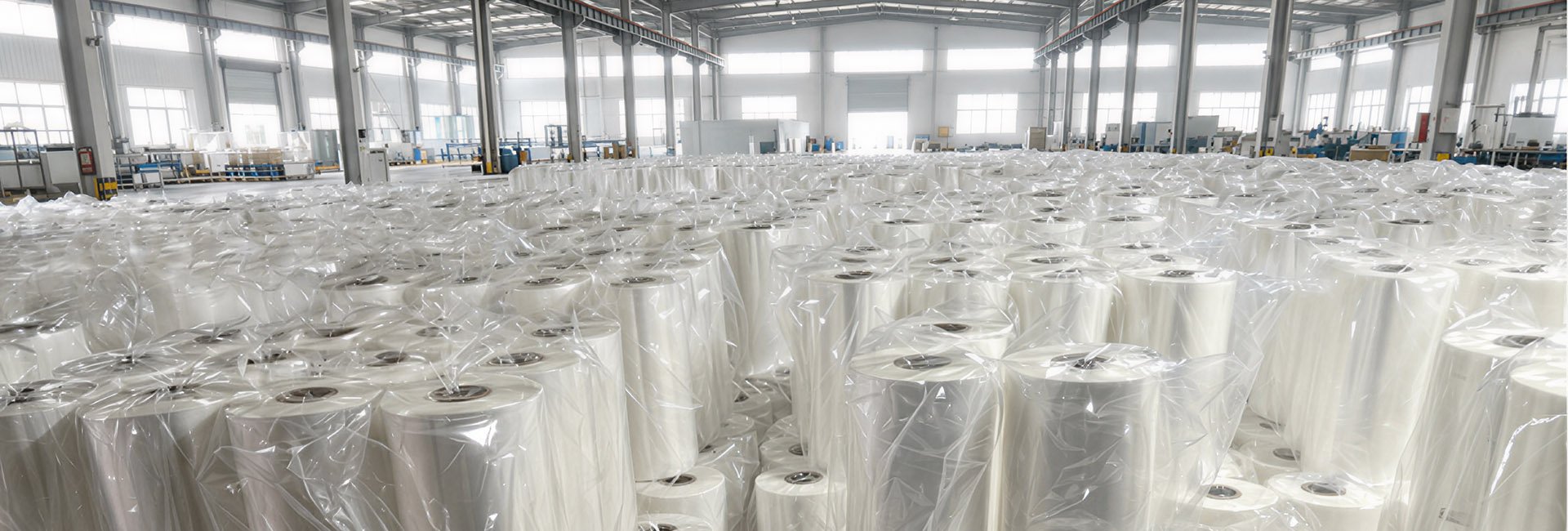
1. The Origin of Heat Shrink Technology (1936)
The concept of heat shrink packaging technology dates back to 1936, when people began experimenting with rubber film to package perishable foods. By heating, the film tightly wrapped around the product, providing protection and preserving freshness. This pioneering idea laid the foundation for modern heat shrink technology.
2. The PVC Era (1960s-1980s)
In the mid-1960s, heat shrink packaging entered commercial application and experienced rapid development in the 1970s. PVC shrink film quickly gained popularity in the United States, Japan, and Europe due to its low cost and good physical properties.
However, PVC had a clear environmental drawback — it releases hydrogen chloride and other harmful gases when incinerated. As global environmental regulations became increasingly strict, PVC shrink film was gradually phased out of the market.
3. The Birth and Rise of POF (1980s-1990s)
POF shrink film originated in Italy in the early 1990s and entered the market as an environmentally friendly alternative to PVC.
Structural innovation:Multi-layer co-extrusion structure combining the flexibility of PE with the heat resistance of PP
Key technology:The "double bubble" process ensures balanced shrinkage in both directions
Market acceptance:Quickly gained popularity in Europe and America, replacing PVC as the mainstream choice for heat shrink packaging
4. The Development of China's POF Industry (1990s - Present)
China's POF industry started with the introduction of foreign technology. Through absorption, innovation, and independent development, Chinese manufacturers have gradually mastered the core technologies. Today, China has become one of the world's largest production bases for POF shrink film, with products exported in large quantities to Europe, America, Southeast Asia, the Middle East, and other markets.
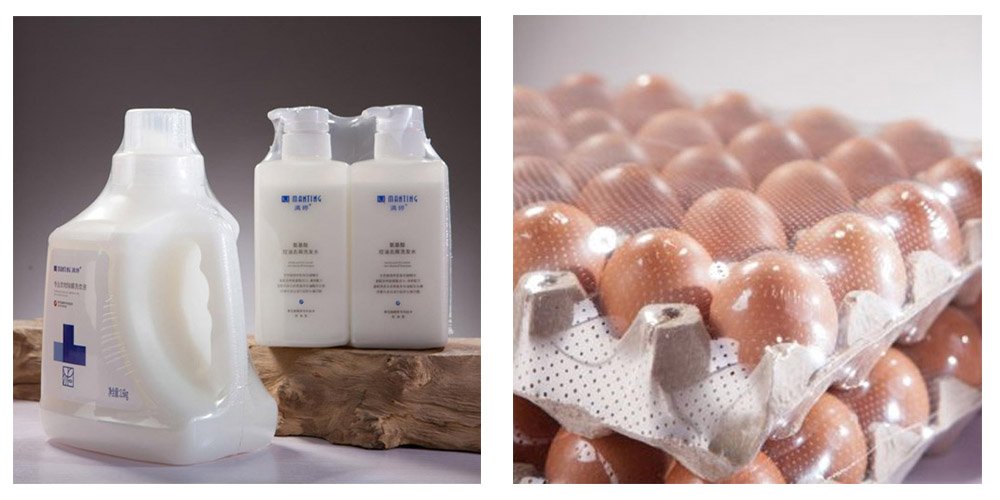
The Manufacturing Process of POF Shrink Film
| Raw Materials and Structure | |||
| Layer | Material | Function | |
| Outer layer | Co-polymer PP | Heat sealability, gloss, heat resistance | |
| Sub-outer layer | Co-polymer PP or LLDPE | Enhanced interlayer bonding and mechanical properties | |
| Middle layer | LLDPE | Strength, flexibility, shrinkage performance | |
| Sub-inner layer | Co-polymer PP or LLDPE | Enhanced interlayer bonding and mechanical properties | |
| Inner layer | Co-polymer PP | Heat sealability, anti-blocking properties | |
The 5-layer co-extruded structure offers more uniform interlayer bonding, more precise thickness control, and more stable shrinkage and mechanical properties compared to 3-layer structures.
Additives such as slip agents, anti-block agents, and antistatic agents are used in production. All raw materials are environmentally friendly and non-toxic, complying with FDA and EU standards.
Core Technology: The Double Bubble Process
This is the core technology of POF production. Unlike ordinary blown film processes, POF undergoes two blowing expansions to achieve its final form
Key Process Parameters:
| Process Step | Key Parameters / Control Points | ||
| Extrusion temperature | Middle layer (LLDPE): approx. 165-180°C; Outer layer (PP): approx. 195-215°C | ||
| First bubble | Rapid water cooling to freeze molecular orientation, forming thick-walled tube | ||
| Second bubble (critical) | Infrared heating to rubbery state (approx. 100-130°C), expansion/stretching to achieve biaxial molecular orientation | ||
| Winding | Rotating winding technology to ensure roll flatness | ||
3. Technical Principle
Why does POF shrink when heated?
The film undergoes a process of molecular orientation followed by "freezing" during production:
The polymer is heated to its rubbery state
External force is applied to align molecular chains in the direction of force (expansion/stretching)
Rapid cooling "freezes" this oriented state
When reheated during use, the molecular chains return to their coiled state, causing the film to shrink tightly around the product
| Comparison of POF vs. Other Shrink Films | |||
| Property | POF | PVC | PE |
| Transparency | Excellent | Good | Low |
| Shrinkage ratio | 60-75% (80% for cross-linked) | 40-50% | 30-40% |
| Environmental friendliness | Non-toxic, chlorine-free | Contains chlorine, harmful when burned | Environmentally friendly |
| Cold resistance | No embrittlement at -50°C | Brittle at low temperatures | Good |
| Heat seal performance | Excellent | Good | Good |
| Food contact safety | FDA certified | Not suitable | Certified |
Future Development Trends
Environmental Sustainability
POF film containing PCR (post-consumer recycled) content is increasingly favored by brand owners
EU regulations such as PPWR are driving continuous improvement in packaging recyclability requirements
Lightweighting and Gauge Reduction
Shrink initiation temperature can be reduced to below 100°C, saving energy and accommodating high-speed packaging lines
Reduction from conventional 20-25μm to 12-15μm, reducing material consumption
Functional Upgrades
Cross-linked film: Electron beam irradiation cross-linking technology, improving heat resistance and seal strength
Smart packaging: Integration of antibacterial, antistatic, UV barrier, and other functions
Market Expansion
Extending from traditional food, beverage, and daily chemical sectors to high-value industries such as electronic components, new energy batteries, and premium pharmaceuticals
Replacing traditional corrugated carton packaging solutions with unitized pallet packaging
Summary
POF shrink film has experienced a journey from the PVC era to the POF material revolution, and from technology import to independent innovation. It has now become a core product in the heat shrink packaging field.
Its core technology, the double bubble process, achieves biaxial molecular orientation through "single extrusion, double expansion," giving the film excellent heat shrink performance. As environmental regulations become stricter and demand for functionality increases, POF continues to evolve toward lightweighting, recyclability, and multi-functionality.

A Professional Manufacturer Specializing in POF Shrink Films and Flexible Packaging Solutions


No.216 1446 Wutai Mountain Road,Huang District,Qingdao,China
COPYRIGHT © 2026 UMI PACKING CO.,LTD.
 Powered By HiCheng

 Español